

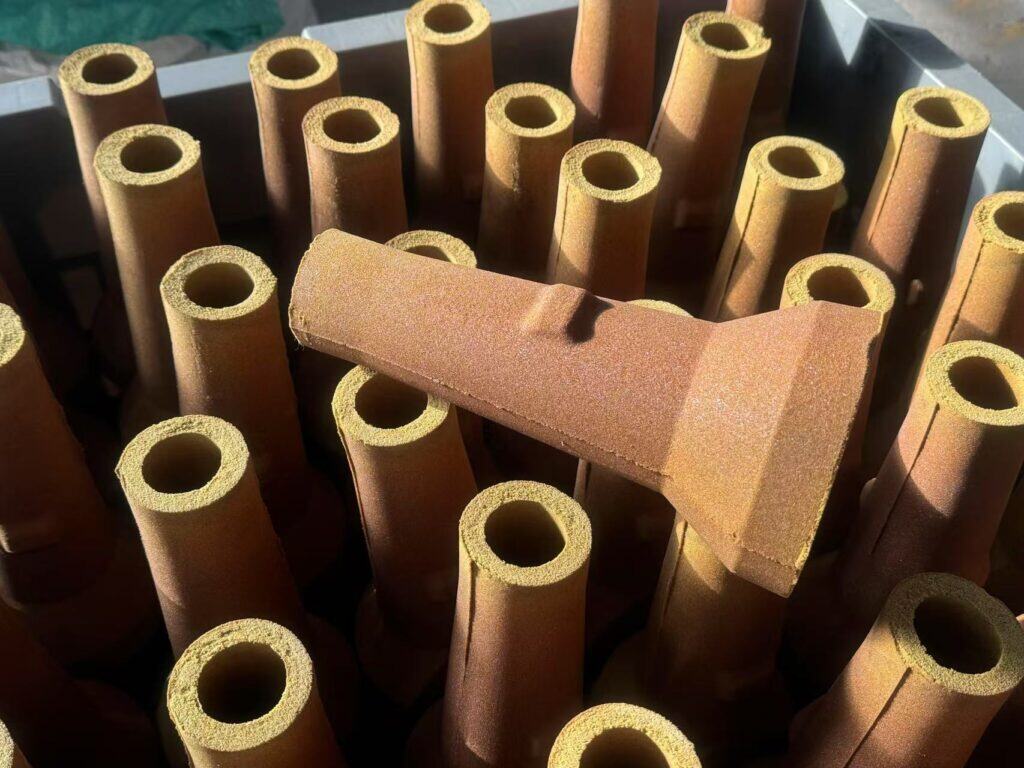
Ball mills and cement mills use diaphragm plates to separate grinding chambers and control material flow between coarse and fine grinding stages. The diaphragm’s slot geometry, free-through-area ratio and material grade determine mill throughput, cement fineness and plate service life. A poorly designed or worn diaphragm causes blockage, over-grinding and reduced output. This guide covers the material grades, slot design and selection criteria for mill diaphragm plates, as part of our broader power generation, cement grinding and powder processing wear-parts program. See our ball mill liner page for the complete mill internals range.
What Are Diaphragm Plates and Why Material Selection Matters
Diaphragm plates (mill diaphragms) are the structural partitions installed inside ball mills and cement mills to separate the grinding chambers — typically the coarse grinding chamber from the fine grinding chamber. They perform two functions simultaneously: separating the chambers so that grinding media stays in its designated zone, and controlling material flow through precisely engineered slots that allow properly ground particles to pass to the next chamber while retaining oversize particles for continued grinding. The diaphragm’s slot width (typically 5–12 mm), free-through-area ratio (4–8% for intermediate diaphragms, 8–12% for discharge diaphragms), and structural design (single-layer or double-layer) directly determine mill throughput, cement fineness and energy efficiency.
The material selection problem is unique to diaphragm plates: unlike shell liners, where wear is the dominant failure mode, diaphragm plates must simultaneously maintain structural stiffness (to resist deflection under the weight of grinding media and material) and slot dimensional stability (to prevent slot widening or deformation that would let oversize material through). A diaphragm whose slots widen from 6 mm to 10 mm due to wear or deformation effectively stops classifying — material rushes through unground, and mill output quality drops. This is why material choice, heat treatment and casting precision all matter for diaphragm plates more than for any other mill liner component.
Diaphragm Plate Material Specifications at a Glance
| Material | Composition | Hardness | Role in diaphragm | Key property |
|---|---|---|---|---|
| Cr-Mo alloy steel | Cr 1.25–2.25%, Mo 0.5–1.0% | HB 300–400 | Main frame & structural body | High strength + stiffness + impact toughness |
| High-manganese steel (Hadfield, 110G13L) | Mn 11–14%, C 1.0–1.4% | HB 400–500 (work-hardened) | Slot segments & guide vanes | Impact work-hardening — surface hardens under service |
| High-chromium cast iron | Cr 15–25%, C 2.4–3.0% | HRC 58–65 | Wear protection plates | Maximum abrasion resistance |
Applicable mill types: ball mills and cement mills. Mill diameter range: 0.9–5.5 m. Plate thickness: 30–80 mm (determined by mill model). Slot width: 5–12 mm. Free-through-area: 4–8% (intermediate diaphragm), 8–12% (discharge diaphragm). Structure: single-layer or double-layer.
Cr-Mo Alloy Steel: The Primary Diaphragm Material
Chromium-molybdenum alloy steel (Cr 1.25–2.25%, Mo 0.5–1.0%) is the primary material for diaphragm plate main frames — and the recommended grade for the structural body of all mill diaphragms. After quench-and-temper heat treatment it reaches HB 300–400, delivering the combination of high tensile strength, structural stiffness and impact toughness that a diaphragm requires. The diaphragm frame must resist deflection under the combined weight of grinding media (which can be several tons), material charge and rotational forces — Cr-Mo steel provides the structural integrity to maintain flatness and slot alignment over years of service.
Compared with plain carbon steel diaphragm plates (the baseline), Cr-Mo alloy steel delivers 2–3× the service life, significantly better slot dimensional stability (heat-treated Cr-Mo deforms less under thermal and mechanical stress), and higher structural stiffness. Carbon steel diaphragms are cheaper but suffer from slot deformation — the slots widen unevenly as the soft steel wears, and thermal cycling in cement mills (hot clinker entering the mill) causes warping that blocks material flow. For any mill running continuously, the Cr-Mo premium pays for itself in avoided downtime and maintained throughput. Cr-Mo steel is the main material we recommend and supply for diaphragm plates.
High-Manganese Steel (Hadfield, 110G13L): Impact Work-Hardening for Slot Segments
High-manganese steel — the Hadfield grade (110G13L, Mn 11–14%, C 1.0–1.4%) — serves a specific role within the diaphragm: slot segments and guide vanes, the components that directly face the flow of grinding media and material. Hadfield steel’s unique property is impact work-hardening: in the as-delivered condition it is relatively soft (approximately HB 200–250), but under repeated impact from grinding balls and ore particles, the surface work-hardens to HB 400–500 — becoming harder in service exactly where the wear is most severe.
This makes Hadfield steel ideal for slot segments in high-impact mills: the surface that takes the most punishment self-hardens to resist wear, while the underlying material retains toughness to resist fracture. The limitation is that Hadfield steel requires sufficient impact to trigger work-hardening — in low-impact environments (fine grinding chambers with small balls) it may not harden adequately and can wear faster than expected. It is also less dimensionally stable than Cr-Mo steel after heat treatment, so it is not used for the main structural frame. Hadfield steel is deployed selectively in slot segments and guide vanes, not as the primary diaphragm material.
High-Chromium Cast Iron: Wear Protection for High-Abraasion Zones
High-chromium cast iron (Cr 15–25%, C 2.4–3.0%) is used for wear protection plates within the diaphragm assembly — the elements that face the highest abrasion from material flow but do not carry the primary structural load. After quench-and-temper heat treatment it achieves HRC 58–65, providing maximum abrasion resistance in the zones where gritty, abrasive material (cement clinker, mineral ore) continuously scours the surface.
The role of hi-chrome in a diaphragm is targeted, not structural. The main frame is Cr-Mo steel for stiffness; the slot segments are Hadfield steel for impact self-hardening; the wear plates are hi-chrome for maximum abrasion resistance. This three-material design — each material matched to its specific duty within the same diaphragm assembly — is how modern diaphragm plates are engineered. Using hi-chrome for the structural frame would risk brittle fracture under the diaphragm’s mechanical loads; using it for slot segments would risk impact failure. Hi-chrome’s place is the wear plate, where abrasion is the sole failure mode and impact is minimal.
Selection Summary by Diaphragm Position and Duty
- Main frame & structural body (stiffness + strength): Cr-Mo alloy steel (HB 300–400) — the primary material for all diaphragm plates.
- Slot segments & guide vanes (impact + abrasion): High-manganese steel (Hadfield 110G13L) — impact work-hardening to HB 400–500 in service.
- Wear protection plates (pure abrasion): High-chromium cast iron (Cr 15–25%, HRC 58–65) — maximum abrasion resistance where impact is minimal.
- Intermediate diaphragm (coarse → fine chamber): Cr-Mo frame + Hadfield slots — 4–8% free-through-area for controlled flow.
- Discharge diaphragm (final chamber → mill exit): Cr-Mo frame + Hadfield slots + hi-chrome wear plates — 8–12% free-through-area for higher flow.
- Low-wear mills (baseline comparison): Plain carbon steel — acceptable only where wear is minimal and slot deformation is tolerable; 2–3× shorter life than Cr-Mo.
Casting, Heat Treatment and Quality Control
Diaphragm plates are cast using resin sand or water-glass sand molding to ensure slot dimensional precision and surface quality — the slot geometry is cast to near-net shape, then finish-machined to final tolerance. Metal is melted in medium-frequency induction furnaces with strict control of Cr, Mo, C and Mn ratios. Heat treatment: Cr-Mo alloy steel is quenched and tempered to HB 300–400 for optimal hardness-toughness balance; Hadfield steel is solution-treated (water-quenched from high temperature) to achieve its austenitic structure; hi-chrome wear plates are quenched and tempered to HRC 58–65.
Slot width is the single most critical dimensional parameter on a diaphragm plate — every plate is inspected slot-by-slot after casting and finish-machining to verify that slot width, spacing and free-through-area meet design specification. Installation faces are milled flat to ensure full contact with the mill shell. Quality inspection includes spectroscopic composition analysis, multi-point hardness testing, full dimensional inspection and metallographic structure examination. ISO 9001 quality system throughout; material and test reports available; supports GOST compliance requirements.
Why Huasuma for Diaphragm Plates
Huasuma controls diaphragm plate quality from the casting source — slot precision and material consistency are built in at the foundry, not reworked afterward. Every casting batch undergoes spectroscopic composition analysis and hardness distribution testing to confirm that Cr-Mo steel reaches its design hardness range after heat treatment. Slot width and free-through-area are the core performance parameters of a diaphragm — Huasuma inspects every plate, slot by slot, in both casting and finish-machining stages, preventing the casting deviation that causes slot deformation, material flow blockage or throughput loss. Single-layer and double-layer designs are customized to mill specification and grinding process, and can be delivered as part of a complete mill liner solution alongside shell liners and lifter bars. With 30 years of casting export experience and multiple batches delivered to Russian, Indian and Australian mill operators, this is proven production. ISO 9001 throughout; 24-hour quote response; samples available for in-service validation before bulk orders. Learn more about our metal casting capability.
FAQ
What material is used for mill diaphragm plates?
The primary material is Cr-Mo alloy steel (HB 300–400), which provides the structural stiffness, strength and impact toughness that the diaphragm frame requires. High-manganese steel (Hadfield 110G13L) is used for slot segments and guide vanes for its impact work-hardening property, and high-chromium cast iron (HRC 58–65) is used for wear protection plates in high-abrasion zones. Each material is matched to its specific duty within the diaphragm assembly.
How long do diaphragm plates last compared to carbon steel?
Cr-Mo alloy steel diaphragm plates deliver 2–3× the service life of plain carbon steel plates. Beyond longer life, the key advantage is slot dimensional stability: carbon steel slots deform and widen under thermal and mechanical stress, causing loss of material classification and reduced mill output — Cr-Mo steel maintains slot geometry far better.
What is the difference between an intermediate and a discharge diaphragm?
An intermediate diaphragm separates two grinding chambers (coarse and fine) inside the mill, with a free-through-area of 4–8% for controlled material flow. A discharge diaphragm is at the mill exit, with a higher free-through-area of 8–12% to allow finished material to leave the mill efficiently. Both use the same Cr-Mo primary material, but slot geometry and flow capacity differ.
Why are slots inspected plate-by-plate?
Slot width directly determines material classification performance — if slots widen from the design 6 mm to 10 mm due to casting deviation or wear, oversize particles pass through unground and mill output quality drops. Every plate is inspected slot-by-slot after casting and machining to verify that slot width, spacing and free-through-area meet specification, preventing throughput loss from dimensional deviation.
Huasuma is a Chinese manufacturer of diaphragm plates (Cr-Mo alloy steel, Hadfield manganese, high-chromium cast iron) for ball mills, cement mills and mineral processing mills. Single-layer and double-layer designs, custom slot geometry, supplied worldwide. Request a quote or sample.