

Heat-treat baskets, fixtures and quench fixtures operate inside carburizing furnaces, quench furnaces and continuous annealing lines at 800–1150°C, where ordinary heat-resistant steel baskets deform, sag and fail within 6–12 months. Cr25Ni20 (ZG4Cr25Ni20Si2) heat-treat baskets resist creep deformation, oxidation and carburization at these temperatures, delivering 12–24 months of continuous service at 1000–1150°C with single-basket load capacity up to 500–2000 kg. This guide covers material grade selection, basket design and performance criteria for heat-treat fixtures, as part of our broader waste incineration and high-temperature furnace wear-parts program.
What Are Heat-Treat Baskets and Why Material Matters
Heat-treat baskets and fixtures are the work-holding components inside heat-treatment furnaces — baskets, grids, supports and trays that hold workpieces during carburizing, quenching, annealing, normalizing and tempering. They are continuously exposed to 800–1150°C, carry workpiece loads of 500–2000 kg per basket, and undergo rapid heating → high-temperature soaking → rapid cooling (quench) thermal-shock cycles. The failure mode is well documented: ordinary ZG30Cr18Ni12Si baskets (900°C-grade) creep-accelerate above 900°C, deforming within 6–12 months — basket bottoms sag, workpieces drop, furnace interiors are damaged, and the line stops for emergency repairs. Material selection is not a commodity decision; it determines whether a basket lasts months or years.
Heat-Resistant Steel Grades for Heat-Treat Baskets
| Grade | Temp. ceiling | Key property | Typical basket duty |
|---|---|---|---|
| ZG304 / ZG316 | ≤ 800°C | Low cost, general-purpose | Low-temp auxiliary fixtures |
| ZG30Cr18Ni12Si | ≤ 900°C | General heat-resistant steel | Medium-temp baskets (baseline) |
| ZG3Cr18Mn12Si2N | ≤ 950°C | Nickel-free, excellent oxidation resistance | Carburizing furnace baskets |
| ZG1Cr25Ni20Si2 | 1000–1100°C | High-temp strength + creep resistance | High-temp baskets |
| ZG4Cr25Ni20Si2 (Cr25Ni20) | 1100–1150°C | Best creep + oxidation + carburization resistance | Quench furnace baskets, heavy-duty fixtures |
| ZG4Cr24Ni48W5Si2 | ≥ 1200°C | Ultra-high-temp, tungsten-alloyed | Extreme-duty furnace cores |
Density: ≈ 7.98 g/cm³. Tensile strength ≥ 392 MPa, yield strength ≥ 220 MPa (room-temperature reference, GB/T 8492). Single-basket load capacity: 500–2000 kg.
ZG30Cr18Ni12Si: The 900°C Baseline — and Why It Fails
ZG30Cr18Ni12Si is the standard heat-resistant steel for medium-temperature furnace baskets operating at 900°C and below. It offers adequate oxidation resistance and creep strength for medium-temperature heat-treatment duties. However, above 900°C its creep rate accelerates significantly: in quench furnace and carburizing furnace service at 900–1000°C, ZG30Cr18Ni12Si baskets typically deform within 6–12 months — basket bottoms sag, walls bulge, and the basket must be scrapped. This is the baseline against which Cr25Ni20 baskets are measured: the 900°C-grade basket is the reason heat-treat operations experience unplanned downtime.
ZG4Cr25Ni20Si2 (Cr25Ni20): The 1150°C Quench-Furnace Workhorse
ZG4Cr25Ni20Si2 — commonly referred to as Cr25Ni20 — is the optimum grade for heat-treat baskets and fixtures operating at 1000–1150°C. With ~25% chromium and ~20% nickel, it forms a stable protective oxide scale that resists spallation under thermal cycling, and its high nickel content stabilizes the austenitic structure against creep. In quench furnace and carburizing furnace service, Cr25Ni20 baskets run 12–24 months continuously at 1000–1150°C — 1.5–2 times the service life of ZG30Cr18Ni12Si baskets under the same conditions. Deformation is held to within 1/2 of industry standard, and long-term load capacity is improved by over 40%. For any basket operating above 1000°C, Cr25Ni20 is the difference between a 2-year service interval and a 6-month replacement cycle.
ZG4Cr24Ni48W5Si2: Ultra-High-Temperature Grade
For heat-treat fixtures operating at 1200°C and above — extreme-duty positions in specialized furnaces — ZG4Cr24Ni48W5Si2 is the ultra-high-temperature grade. With ~48% nickel and tungsten addition, it maintains structural stability and creep resistance where even Cr25Ni20 would degrade. This grade is specified for the most demanding positions where failure would cause extended downtime. The trade-off is cost: the high nickel and tungsten content makes it significantly more expensive than Cr25Ni20, so it is reserved for positions where the temperature ceiling truly demands it.
Performance vs Standard Heat-Resistant Steel Baskets
Compared with standard ZG30Cr18Ni12Si baskets (900°C-grade), Cr25Ni20 baskets extend the temperature ceiling to 1100–1150°C (+250°C), reduce creep rate by over 50% at 1000°C, and deliver 1.5–2 times the service life at 1000°C and above. High-temperature oxidation weight-gain is far lower than low-nickel heat-resistant steel. In customer-validated service, long-term load capacity is improved by over 40% and deformation is held to within 1/2 of industry standard. The practical effect: where a ZG30Cr18Ni12Si basket deforms in 6–12 months and forces an unplanned furnace shutdown, a Cr25Ni20 basket runs 12–24 months under the same conditions — reducing replacement frequency, maintenance labor and downtime by nearly half.
Selection Summary by Furnace Type and Temperature
- Quench furnace baskets (1000–1150°C, heavy load + thermal shock): Cr25Ni20 — creep resistance + oxidation resistance + carburization resistance for 12–24 month service life.
- Carburizing furnace baskets (≤ 950°C, carburizing atmosphere): ZG3Cr18Mn12Si2N — nickel-free, excellent oxidation resistance in carburizing atmospheres, lower cost.
- Medium-temp baskets (≤ 900°C): ZG30Cr18Ni12Si — cost-effective where high-Ni grades are over-specified, but monitor for creep above 900°C.
- Continuous annealing/normalizing/tempering lines: Cr25Ni20 — long service life under repeated thermal cycling and continuous load.
- Ultra-high-temp fixtures (≥ 1200°C): ZG4Cr24Ni48W5Si2 — tungsten-alloyed for extreme duty.
- Low-temp auxiliary fixtures (≤ 800°C): ZG304 / ZG316 — economical for non-critical, low-temperature positions.
Casting Process and Quality Control
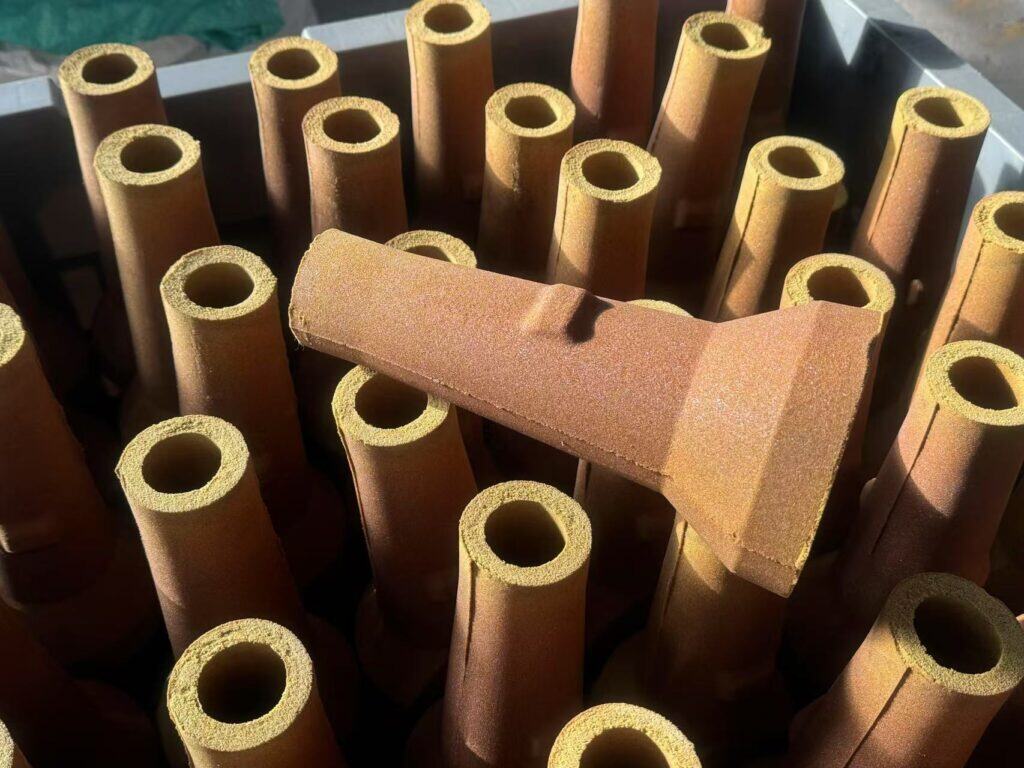
Heat-treat baskets are produced by lost-foam casting — the optimum process for complex basket structures, producing a one-piece monolithic basket without welded joints that would be weak points under thermal cycling. Pouring temperature is 1530–1570°C. A pre-pour “double rule” — furnace-front temperature measurement plus sample-block chemistry check — ensures chemical composition meets specification before pouring. Heat treatment consists of solution treatment plus stabilization to eliminate casting residual stress and stabilize high-temperature performance; different grades use different parameters.
Quality control includes spectroscopic material testing to confirm core elements (Cr, Ni, Si, C) on every piece, high-temperature performance sampling (oxidation weight-gain rate, creep rate), dimensional tolerance verification — all fully traceable. ISO 9001 quality system throughout; material and test reports available. Supports GOST compliance requirements.
Why Huasuma for Heat-Treat Baskets
Huasuma’s metal casting capability covers six heat-resistant steel grades spanning the full 800–1200°C temperature range — from ZG304 for low-temperature auxiliary fixtures to ZG4Cr24Ni48W5Si2 for ultra-high-temperature positions. Each basket has a grade matched to its furnace temperature, not one alloy for all duties. Basket structures are optimized by thermodynamic simulation and load-distribution analysis — ensuring uniform workpiece heating and rational stress distribution to prevent localized overheating and early deformation. Lost-foam one-piece casting eliminates welded-joint weak points. Every piece receives spectroscopic material confirmation and high-temperature performance sampling before shipment. With 30 years of heat-resistant casting experience and Cr25Ni20 series cumulative deliveries exceeding 500 tons to Russian clients, this is proven production — not sample trials. ISO 9001 throughout; 24-hour quote response; samples available for in-service validation before bulk orders.
FAQ
What is the best material for heat-treat baskets?
For baskets operating at 1000–1150°C in quench furnaces and carburizing furnaces, ZG4Cr25Ni20Si2 (Cr25Ni20) is the optimum grade — its 25% Cr / 20% Ni content provides creep resistance, oxidation resistance and carburization resistance for 12–24 months of continuous service at 1000–1150°C, with single-basket load capacity up to 500–2000 kg.
How long do Cr25Ni20 heat-treat baskets last?
Cr25Ni20 baskets typically deliver 12–24 months of continuous service at 1000–1150°C, compared with 6–12 months for ordinary ZG30Cr18Ni12Si baskets above 900°C. Deformation is held to within 1/2 of industry standard, and long-term load capacity is improved by over 40%.
When should I use ZG3Cr18Mn12Si2N instead of Cr25Ni20?
Choose ZG3Cr18Mn12Si2N for carburizing furnace baskets operating at 950°C and below — it is a nickel-free heat-resistant steel with excellent oxidation resistance in carburizing atmospheres, at lower cost than Cr25Ni20. Above 950°C, Cr25Ni20 is required for adequate creep strength.
What is the temperature ceiling of heat-treat basket materials?
The temperature ceiling depends on grade: ZG30Cr18Ni12Si is rated for 900°C, ZG3Cr18Mn12Si2N for 950°C, ZG1Cr25Ni20Si2 for 1000–1100°C, ZG4Cr25Ni20Si2 (Cr25Ni20) for 1100–1150°C, and ZG4Cr24Ni48W5Si2 for 1200°C and above.
Huasuma is a Chinese manufacturer of heat-resistant steel heat-treat baskets and fixtures (Cr25Ni20, ZG4Cr24Ni48W5Si2, ZG3Cr18Mn12Si2N and custom high-nickel alloys) for carburizing furnaces, quench furnaces and continuous heat-treatment lines. Baskets, grids, supports and trays supplied worldwide. Request a quote or sample.