

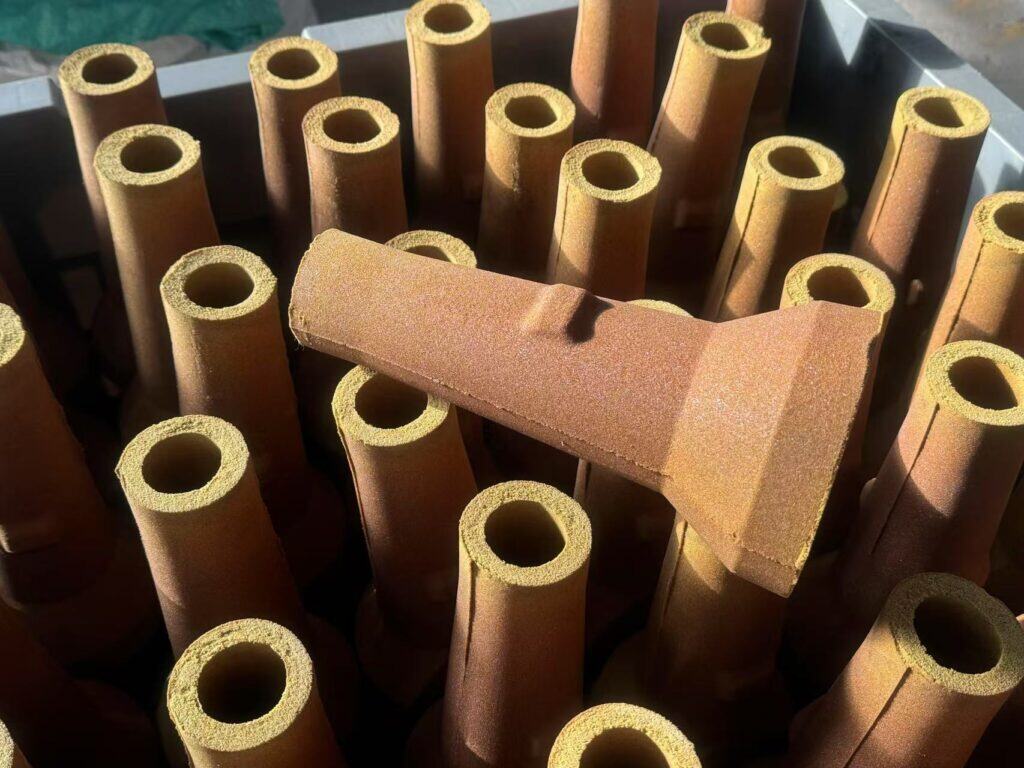
Wear plate blades — the wear-resistant plates, impact plates and mixer blades inside crushers and concrete mixers — take the relentless force of hard rock and abrasive aggregate sliding across their surface at high frequency. Ordinary cast steel blades in a concrete mixer last only 3–6 months before wear degrades mixing efficiency and concrete quality; high manganese steel wear plates depend on strong impact to work-harden and underperform in medium-to-low impact conditions. High-chrome white cast iron wear plates and blades (KmTBCr15 / KmTBCr20 / KmTBCr26) deliver HRC 50–63 as a factory-final hardness — no work-hardening needed — with 1.2–1.5 times the wear life of manganese steel. This guide covers the material grades, selection criteria and quality control for wear plate blades, as part of our broader mining, crushing and aggregate processing wear-parts program. See our crusher wear parts catalog for the complete range.
What Are Wear Plate Blades and Why Material Matters
Wear plate blades are the wear-resistant liners and blades inside hammer crushers, impact crushers, cone crushers and concrete mixers. In a hammer or impact crusher they serve as impact plates that the rock strikes after being hit by the hammer or blow bar; in a cone crusher they function as guard and liner plates; in a concrete mixer they are the mixing blades and drum liners that contact sand, aggregate and cement continuously. The failure mode is abrasive sliding wear combined with high-frequency impact. The material problem is the same as for other crushing wear parts: high manganese steel needs strong impact to work-harden, but many wear-plate positions experience medium-to-low impact, so the manganese surface never hardens effectively and wears fast. High-chrome cast iron delivers HRC 50–63 as the final heat-treated hardness, and its secondary-hardening heat treatment produces a carbide structure that outperforms conventional single-stage heat treatment in the same material. The selection problem is matching the chromium level to the wear severity and impact energy of the specific position.
High-Chrome Cast Iron Wear Plate Grades at a Glance
| Grade | Cr content | Hardness (HT) | Impact toughness | Typical duty |
|---|---|---|---|---|
| KmTBCr15 | 14–18% | HRC 50–58 | ≥ 10 J/cm² | Limestone, aggregate, mixer blades |
| KmTBCr20 | 18–23% | HRC 55–62 | ≥ 10 J/cm² | Iron ore, manufactured sand |
| KmTBCr26 | 23–28% | HRC 60–63 | ≥ 10 J/cm² (HT-guaranteed) | Extreme wear, high-hardness rock |
Density: 7.2–7.5 g/cm³. Core chemistry: C 2.0–3.0%, Cr 14–28% depending on grade. Casting: water-glass sand, resin sand or coated sand (selected by product size and precision). Hardness tested at 3 points per piece; HRC 50–63 as factory gate.
KmTBCr15: The General-Duty Grade
KmTBCr15 (14–18% chromium) is the general-duty grade for wear plates and blades in moderate-wear conditions — limestone, construction aggregate and concrete mixer applications. After secondary-hardening heat treatment it reaches HRC 50–58, already two to three times the cast hardness of manganese steel (HB 179–219), with no dependence on in-service work-hardening. For concrete mixer blades and drum liners, where ordinary cast steel wears through in 3–6 months, Cr15 blades at HRC 50+ run 6–12 months with uniform, controllable wear. Its advantage is the combination of adequate wear resistance with the best toughness in the series (≥ 10 J/cm²), making it the standard choice for positions where impact is variable and a tougher material reduces cracking risk. For extreme-wear positions, the higher-chromium grades are needed.
KmTBCr20: The High-Wear Balance Grade
KmTBCr20 (18–23% chromium) is the balanced grade for high-wear duty combined with medium impact — iron ore, manufactured sand and high-hardness aggregate crushing. The higher chromium content increases the volume of hard M₇C₃ carbides, pushing hardness to HRC 55–62 and raising wear resistance above Cr15 while maintaining impact toughness at ≥ 10 J/cm². For impact crusher wear plates handling hard rock, where the plate surface takes both high-frequency impact and abrasive sliding, Cr20 provides the balance of wear life and crack resistance that makes it the standard high-duty choice. The secondary-hardening heat treatment parameters are tuned for this chromium level, transforming the carbide morphology from network M₃C to isolated M₇C₃ rods and delivering overall performance (strength + hardness + toughness) superior to conventional single-stage heat treatment in the same material.
KmTBCr26: The Extreme-Wear Grade
KmTBCr26 (23–28% chromium) is the top wear-resistance grade for extreme-wear conditions with high-hardness materials. With the highest chromium content, it produces the greatest volume of hard M₇C₃ carbides, reaching HRC 60–63 for maximum abrasive wear resistance. The trade-off is that higher carbide volume reduces inherent toughness, so Cr26’s impact toughness must be guaranteed through the secondary-hardening heat treatment — the quench-and-temper parameters are specifically designed to control carbide morphology and maintain the ≥ 10 J/cm² toughness floor. This grade is specified for the most abrasive materials and the most demanding wear-plate positions — cone crusher liners in high-hardness ore, impact crusher plates in extreme service — where maximizing plate life is the priority and impact is moderate enough that toughness can be heat-treatment-guaranteed.
Selection Summary by Application
- Concrete mixer blades and liners: KmTBCr15 — HRC 50+ gives 6–12 month life vs 3–6 months for cast steel; uniform wear preserves mixing quality.
- Hammer / impact crusher wear plates (limestone, aggregate): KmTBCr15 — adequate wear resistance with best toughness for variable impact.
- Impact crusher wear plates (iron ore, hard rock): KmTBCr20 — HRC 55–62, balanced wear and toughness for high-frequency impact + sliding.
- Cone crusher liners (extreme-wear, high-hardness ore): KmTBCr26 — HRC 60–63, maximum wear resistance, toughness heat-treatment-guaranteed.
- Medium-to-low impact positions: Always high-chrome cast iron over manganese steel — manganese cannot work-harden effectively without strong impact.
Performance: High-Chrome Cast Iron vs High Manganese Steel
Compared with high manganese steel (Mn13Cr2, cast hardness HB 179–219), high-chrome white cast iron wear plates deliver HRC 50–63 as the factory-final hardness — two to three times higher — with no dependence on in-service work-hardening. In the medium-to-low impact conditions common in wear-plate and mixer-blade positions, where manganese steel stays soft, high-chrome plates provide 1.2–1.5 times the wear life. The critical difference is the secondary-hardening heat treatment: by transforming the carbide morphology from the brittle network M₃C to the isolated rod-like M₇C₃, the same material achieves higher overall performance (strength + hardness + impact toughness) than conventional single-stage heat treatment. For concrete mixer blades specifically, the improvement is dramatic — from 3–6 months with cast steel to 6–12 months with Cr15 at HRC 50+, with uniform, predictable wear that maintains mixing efficiency throughout the service period.
Casting Process and Quality Control
Wear plates and blades are produced by water-glass sand casting, resin sand casting or coated-sand casting, selected by product size and precision requirements; the molding process ensures a dense internal structure. Chemical composition is strictly controlled, with micro-alloy treatment to optimize carbide morphology. Pouring temperature, pouring speed and secondary feeding are all executed per process card, with furnace-front temperature measurement and rapid chemistry check before pouring. Heat treatment is a secondary-hardening process (quench plus temper) that transforms the carbide morphology from network M₃C to isolated M₇C₃ — this is what gives Huasuma wear plates overall performance superior to conventional single-stage heat treatment in the same material.
Quality control includes incoming raw-material spectroscopic testing of Cr and C core elements, in-process casting inspection, 100% finished-product hardness testing (3 points per piece), metallographic analysis to confirm carbide morphology, and dimensional tolerance verification — all fully traceable. ISO 9001 quality system throughout; material and test reports available. Supports GOST compliance requirements.
Why Huasuma for Wear Plate Blades
Wear plates and mixer blades are the core consumables of crushing and mixing equipment, and their performance depends on high-chrome cast iron composition control, carbide morphology and secondary-hardening heat treatment — requirements far higher than for ordinary cast iron or cast steel. Huasuma’s metal casting capability offers three grades (KmTBCr15 / Cr20 / Cr26), each with independent quench-and-temper parameters — limestone and mixer duty uses Cr15 for economy, iron ore duty uses Cr26 for maximum life; not one formula for all duties. Secondary-hardening heat treatment transforms carbides from network M₃C to isolated M₇C₃ — confirmed by metallographic analysis on every piece, delivering overall performance superior to conventional single-stage heat treatment of the same material. Pre-pour furnace-front temperature and chemistry check, 100% finished hardness testing (3 points per piece), metallographic carbide confirmation and dimensional verification. Products can be designed for the customer’s actual duty and equipment — not standard parts forced to fit the duty, but material selection optimized to the duty. ISO 9001 throughout; supports GOST compliance; material reports, test reports and hardness distribution charts available. With 30 years of high-chrome cast iron wear-part manufacturing experience, 10,000+ tons annual capacity, supply to multiple domestic crusher OEMs, and exports to India, Indonesia, Vietnam, Australia and Russia, this is a proven large-scale supply chain. 24-hour quote response; samples available for in-service validation before bulk orders.
FAQ
What is the best material for concrete mixer blades?
High-chrome white cast iron KmTBCr15 is the standard choice for concrete mixer blades and liners. At HRC 50+ it runs 6–12 months versus 3–6 months for ordinary cast steel, with uniform, controllable wear that maintains mixing efficiency and concrete quality throughout the service period. Its toughness (≥ 10 J/cm²) handles the variable impact in mixer drums.
How does high-chrome cast iron compare with manganese steel for wear plates?
High-chrome cast iron delivers HRC 50–63 as the factory-final hardness — two to three times the cast hardness of manganese steel (HB 179–219) — with no dependence on work-hardening. In medium-to-low impact conditions where manganese steel stays soft, high-chrome wear plates provide 1.2–1.5 times the wear life. The secondary-hardening heat treatment further improves overall performance beyond what conventional heat treatment achieves in the same material.
What is secondary hardening and why does it matter?
Secondary hardening is a quench-and-temper heat treatment that transforms the carbide morphology in high-chrome cast iron from the brittle network M₃C form to the isolated rod-like M₇C₃ form. The network M₃C creates a continuous crack path; the isolated M₇C₃ rods interrupt it, giving the material both high hardness and adequate toughness. This is why Huasuma wear plates in the same material outperform conventionally heat-treated products.
Can wear plates be custom-made for my crusher or mixer model?
Yes. Wear plate shape, dimensions and installation holes can be customized to the specific crusher or mixer model. Different material grades can be selected for different positions within the same equipment to optimize overall utilization — for example, Cr26 for the highest-wear position and Cr15 for a lower-wear position in the same machine.
Huasuma is a Chinese manufacturer of wear plate blades and mixer liners in high-chrome white cast iron (KmTBCr15, KmTBCr20, KmTBCr26) for crushers and concrete mixers. HRC 50–63, 1.2–1.5 times the wear life of manganese steel. Supplied worldwide. Request a quote or sample.