

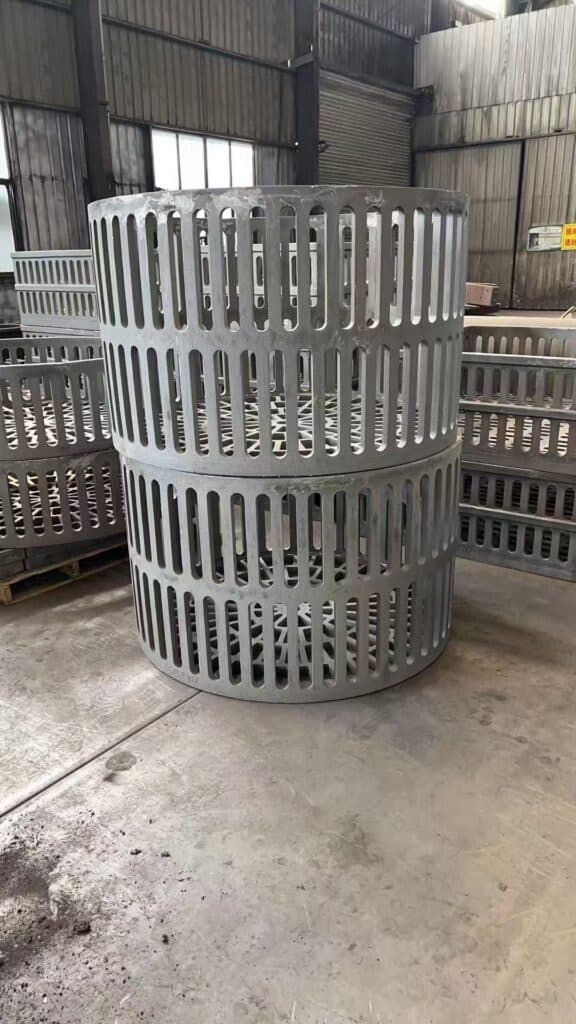
Heat-treatment tooling — baskets, fixtures, grids and trays — operates inside pit furnaces, rotary hearth furnaces, box furnaces and continuous annealing lines at 800–1150°C, where ordinary heat-resistant steel fixtures deform under load and thermal-shock cycling within months. Two fixture design families address different furnace geometries: circular fixtures for cylindrical furnace chambers (pit furnaces, rotary hearth furnaces) and combined modular fixtures for box and car-bottom furnaces. Both are manufactured from Cr25Ni20 (ZG4Cr25Ni20Si2) and related heat-resistant steel grades, delivering 1.5–2 times the service life of ordinary ZG30Cr18Ni12Si fixtures at 1000°C and above. This guide covers circular and combined fixture design, material selection and configuration strategy, as part of our broader сжигание отходов и высокотемпературная печь wear-parts program. For the component range, see our heat-resistant furnace castings стр.
What Are Circular and Combined Heat-Treatment Fixtures
Circular fixtures are cylindrical baskets, crucibles and loading trays designed for pit furnaces and rotary hearth furnaces — furnaces with cylindrical chambers where a circular basket matches the furnace geometry, ensuring uniform heating and smooth gas circulation that a square basket cannot achieve. Combined modular fixtures are assembly systems of cast grid plates, pillars and trays that configure freely into 2–5 layer stacks — unlike integral one-piece baskets, each component can be independently replaced and reconfigured. The choice between circular and combined depends on furnace type: circular for cylindrical chambers, combined for box furnaces, car-bottom furnaces and continuous lines. Both share the same six-grade material system covering 800–1200°C.
Марки и характеристики материалов
| Класс | Температурный потолок | Ключевая недвижимость | Typical fixture duty |
|---|---|---|---|
| ZG304 / ZG316 | ≤ 800 ° С | Низкая стоимость, универсальное назначение | Низкотемпературные вспомогательные светильники |
| ZG30Cr18Ni12Si | ≤ 900 ° С | Обычная жаропрочная сталь | Medium-temp baskets, pillars, trays |
| ZG3Cr18Mn12Si2N | ≤ 950 ° С | Не содержит никеля, обладает превосходной стойкостью к окислению. | Carburizing furnace fixtures |
| ZG1Cr25Ni20Si2 | 1000-1100 ° С | Высокая термостойкость + сопротивление ползучести | Grid plates, core load-bearing |
| ZG4Cr25Ni20Si2 (Cr25Ni20) | 1100-1150 ° С | Наилучшая устойчивость к ползучести, окислению и науглероживанию. | Circular baskets, combined grids |
| ZG4Cr24Ni48W5Si2 | ≥ 1200 ° С | Сверхвысокотемпературный сплав вольфрама | Extreme-duty furnace positions |
Circular fixture diameter: 200–1200 mm (custom to furnace chamber). Single-basket load: 100–2000 kg (small 100–500 kg, medium 500–1000 kg, large 1000–2000 kg). Combined fixtures: 2–5 layer stacks (≤ 3 layers recommended for high-temperature duty). Tensile strength ≥ 392 MPa, yield strength ≥ 220 MPa (room-temperature reference, GB/T 8492). Density ≈ 7.98 g/cm³.
Circular Fixtures: Geometry Advantages in Pit and Rotary Hearth Furnaces
Circular fixtures are purpose-built for pit furnaces and rotary hearth furnaces. In a pit furnace, the cylindrical chamber is matched by a circular basket — workpieces receive more uniform heat than in a square basket forced into a round chamber, and gas circulation is smoother. In carburizing, quenching and annealing cycles, the basket undergoes rapid heating → high-temperature soaking → rapid cooling thermal-shock cycles. The circular structure distributes thermal stress uniformly — deformation and cracking risk is lower than in square structures under the same thermal-shock conditions. Rotary hearth furnaces present a different advantage: workpieces rotate with the hearth, and circular tooling naturally matches the rotational motion, enabling convenient loading and unloading.
Compared to square baskets of the same Cr25Ni20 grade, circular baskets provide superior heating uniformity (better chamber fit, smoother gas flow), superior thermal-shock tolerance (uniform stress distribution), and are purpose-matched to pit and rotary hearth furnace geometries. Square baskets remain the choice for box furnaces and car-bottom furnaces.
Combined Modular Fixtures: Grid, Pillar and Tray System
Combined modular fixtures consist of three component types: grid plates that carry workpieces and allow airflow, pillars that provide inter-layer support and positioning, and trays that form the bottom load-bearing layer and separate workpieces. These components assemble freely into 2–5 layer configurations — up to 3 layers for high-temperature duty. The defining advantage over integral one-piece baskets is operational: when a grid plate wears, it is replaced individually; pillars and trays continue in service. Different workpiece sizes and loading densities are accommodated by adjusting layer spacing and grid layout — no need to purchase a purpose-built integral basket for each workpiece type. Inventory is streamlined: a set of standard modules covers multiple furnace duties, replacing multiple purpose-built integral baskets.
The mixed-material configuration strategy is unique to combined fixtures: high-temperature core load-bearing components (grid plates) can be specified in Cr25Ni20, while auxiliary components (pillars, trays) use a lower grade such as ZG30Cr18Ni12Si — optimizing the cost-to-performance ratio. First purchase cost is slightly higher than an integral basket (modular design plus assembly labor), but lifecycle cost is significantly lower due to single-component replacement.
Сравнение характеристик со стандартной жаростойкой сталью.
Compared with ordinary ZG30Cr18Ni12Si fixtures (900°C-grade), Cr25Ni20 circular and combined fixtures extend the temperature ceiling to 1100–1150°C (+250°C), reduce creep rate by over 50% at 1000°C, and deliver 1.5–2 times the service life at 1000°C and above. High-temperature oxidation weight-gain is far lower than low-nickel heat-resistant steel. For circular fixtures specifically, the uniform stress distribution of the circular geometry provides additional thermal-shock tolerance beyond what the material grade alone delivers — deformation is held to within 1/2 of industry standard, and long-term load capacity is improved by over 40%.
Сводная информация по выбору печи в зависимости от типа и температуры
- Pit furnace / rotary hearth furnace (800–1150°C): Circular fixture, Cr25Ni20 — geometry match + thermal-shock tolerance + creep resistance.
- Box furnace / car-bottom furnace (1000–1150°C): Combined modular fixture, Cr25Ni20 — flexible configuration + single-component replacement.
- Линии непрерывного отжига/нормализации/закалки: Combined modular, Cr25Ni20 — long service under repeated cycling, worn grids individually replaceable.
- Carburizing furnace (≤ 950°C): Circular or combined, ZG3Cr18Mn12Si2N — nickel-free, excellent oxidation resistance in carburizing atmosphere.
- Medium-temp fixtures (≤ 900°C): ZG30Cr18Ni12Si — cost-effective pillars and trays in combined fixtures.
- Ultra-high-temp positions (≥ 1200°C): ZG4Cr24Ni48W5Si2 — сплав вольфрама для экстремальных условий эксплуатации.
- Mixed-material combined fixture: Cr25Ni20 grid plates + ZG30Cr18Ni12Si pillars/trays — optimized cost-to-performance.
Casting, Assembly and Quality Control
Circular fixtures are produced by lost-foam casting — the optimum process for complex circular basket structures, producing a monolithic one-piece basket without welded joints. Combined fixture components are cast individually by lost-foam casting (grid plates with complex ventilation structures) and sand casting (pillars, trays), then assembled. Pouring temperature is 1530–1570°C. A pre-pour “double rule” — furnace-front temperature measurement plus sample-block chemistry check — ensures chemical composition meets specification before pouring. Assembly uses cast positioning structures (register tabs and slots, cast clamps) that maintain inter-layer positioning and resist loosening under high-temperature load.
Heat treatment: solution treatment plus stabilization, eliminating casting residual stress and stabilizing high-temperature performance — different parameters per grade. Quality control: spectroscopic material testing (Cr, Ni, Si, C) on every component; high-temperature performance sampling; dimensional tolerance verification including circular fixture diameter and roundness; combined fixture assembly precision verification — all fully traceable. ISO 9001 throughout; supports GOST compliance requirements.
Why Huasuma for Heat-Treatment Tooling
Хуасума литье металла capability covers six heat-resistant steel grades spanning the full 800–1200°C range, applied to both circular and combined fixture designs. Circular fixture structures are optimized by thermodynamic simulation — grid density, wall thickness and lifting point positions are engineered for uniform heating and rational stress distribution. Combined fixture components are optimized by load-density simulation and modular stress analysis — grid plate ventilation hole layout, pillar cross-section and connection structure, tray load distribution all receive targeted engineering. The mixed-material strategy allows high-grade Cr25Ni20 for core load-bearing components and economic grades for auxiliaries — each component matched to its duty temperature, not one alloy for all positions. Lost-foam one-piece casting (circular) and individual component casting plus precision assembly (combined) eliminate weak points. Every component receives spectroscopic material confirmation before shipment. With 30 years of heat-resistant casting experience and multiple batches delivered to Russian furnace operators, this is proven production. ISO 9001 throughout; 24-hour quote response; samples available for in-service validation.
FAQ
When should I choose circular fixtures vs combined modular fixtures?
Choose circular fixtures for pit furnaces and rotary hearth furnaces — cylindrical chambers require cylindrical baskets for uniform heating and gas circulation. Choose combined modular fixtures for box furnaces, car-bottom furnaces and continuous heat-treatment lines where flexible configuration and single-component replacement are the priority.
Can I mix material grades within a single combined fixture?
Yes. The mixed-material strategy specifies high-temperature Cr25Ni20 for core load-bearing grid plates and a lower grade such as ZG30Cr18Ni12Si for auxiliary pillars and trays — optimizing cost-to-performance. Each component is matched to its actual operating temperature, not one alloy for all positions.
What diameter range is available for circular fixtures?
Circular fixture diameters range from 200 to 1200 mm, custom-manufactured to the furnace chamber specification. Single-basket load capacity ranges from 100 to 2000 kg depending on diameter and duty — small baskets 100–500 kg, medium 500–1000 kg, large 1000–2000 kg.
How many layers can a combined modular fixture support?
Combined fixtures support 2–5 layer configurations. For high-temperature duty (1000°C and above), a maximum of 3 layers is recommended to ensure structural stability and inter-layer connection reliability under thermal cycling.
Huasuma is a Chinese manufacturer of heat-treatment tooling — circular baskets, crucibles and combined modular fixtures (grid, pillar, tray) — in Cr25Ni20, ZG4Cr24Ni48W5Si2, ZG3Cr18Mn12Si2N and custom high-nickel alloys for pit furnaces, rotary hearth furnaces, box furnaces and continuous heat-treatment lines. Supplied worldwide. Запросить расценки или образец.