

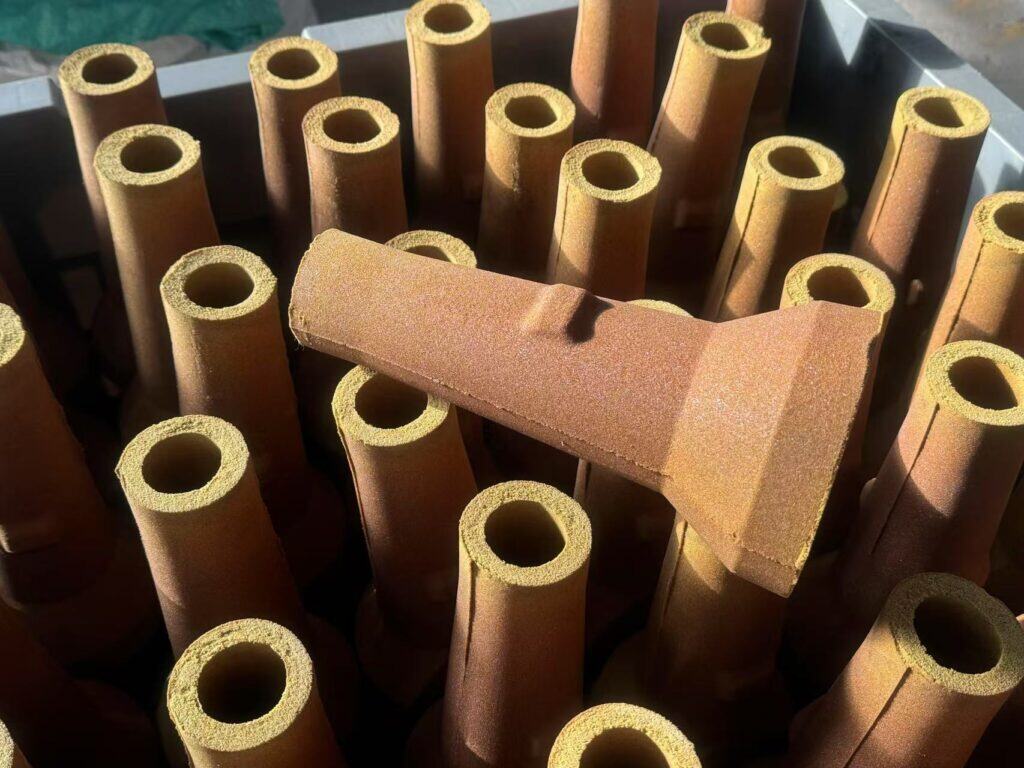
Crusher guard plates — also called side liners — protect the side walls of the crushing chamber in jaw and cone crushers. During crushing, material is squeezed between the jaw plates or cone mantle and concave, and the side walls take the full force of abrasive cutting combined with lateral impact. Ordinary carbon steel side plates wear through in weeks, exposing the crusher frame to damage that costs far more to repair than a set of guard plates. High manganese steel guard plates (Mn13Cr2 / Mn18Cr2 / Mn22Cr2Mo) start at a cast hardness of HB 170–230 and work-harden to HB 300–450+ under impact, so the harder the duty, the harder the surface becomes. This guide covers the material grades, selection criteria and quality control for crusher guard plates, as part of our broader mining, crushing and aggregate processing wear-parts program. See our crusher wear parts catalog for the complete jaw and cone wear-parts range.
What Are Crusher Guard Plates and Why Material Matters
Crusher guard plates are bolt-on liners mounted on the side walls of the crushing chamber in jaw crushers (PE/PEX series) and cone crushers. In a jaw crusher they sit between the fixed jaw plate and the swing jaw plate, preventing material from packing into the gap between the jaw and the frame while shielding the frame side wall from abrasive wear. In a cone crusher they line the feed area where lateral impact and sliding wear are most severe. The failure mode is abrasive cutting by hard rock combined with lateral impact from material being squeezed outward. No single manganese grade is optimal for all duties — the selection problem is matching the steel’s work-hardening response and impact toughness to the material being crushed and the impact energy of the machine. Soft limestone needs only Mn13Cr2; granite and iron ore demand Mn18Cr2 or Mn22Cr2Mo to avoid cracking under high impact.
High Manganese Steel Guard Plate Grades at a Glance
| Grade | Cast hardness | Work-hardened | Impact toughness | Typical duty |
|---|---|---|---|---|
| Mn13Cr2 | HB 170–230 | HB 300–400 | ≥ 80 J/cm² | Limestone, medium-hard rock |
| Mn18Cr2 | HB 180–260 | HB 450+ | ≥ 120 J/cm² | Granite, iron ore, high impact |
| Mn22Cr2Mo | HB 180–260 | HB 450+ | ≥ 120 J/cm² | Extreme impact + wear |
Thickness: typically 20–80 mm depending on crusher size. Single-piece weight: typically 15–150 kg. Installation: bolt-on (bolt holes per machine model). Density: 7.8–8.0 g/cm³. Applicable standard: GOST 977-88 (steel castings).
Mn13Cr2: The Standard High Manganese Steel Grade
Mn13Cr2 is the standard work-hardening manganese steel for guard plates operating in medium-duty applications — limestone, medium-hard rock and general aggregate. Its cast hardness of HB 170–230 is modest, but under impact the surface work-hardens to HB 300–400, giving good wear resistance exactly where the crushing action is strongest. Its advantage is cost-effectiveness: for limestone and similar medium-hardness materials, Mn13Cr2 provides adequate service life at the lowest material cost. The limitation is impact toughness — at ≥ 80 J/cm² it is sufficient for medium impact, but in high-impact duty crushing granite or iron ore, Mn13Cr2 guard plates are prone to cracking, and the lower work-hardening ceiling means faster wear in the hardest positions.
Mn18Cr2: The High-Impact Grade
Mn18Cr2 is the upgraded manganese steel for guard plates in high-impact, hard-rock crushing. By raising manganese to ~18% and chromium to ~2%, the cast hardness increases to HB 180–260 and the work-hardening ceiling reaches HB 450+ — significantly above Mn13Cr2’s HB 300–400. The critical difference is impact toughness: at ≥ 120 J/cm², Mn18Cr2 has 50% greater crack resistance than Mn13Cr2 (≥ 80 J/cm²), making it the preferred grade for granite, iron ore and other high-impact duties where Mn13Cr2 would crack. For cone crusher feed-zone guard plates, where lateral impact is severe, Mn18Cr2’s combination of higher work-hardening and higher toughness makes it the standard choice. The trade-off is material cost — Mn18Cr2 is more expensive than Mn13Cr2, so it is reserved for duties where the impact genuinely demands it.
Mn22Cr2Mo: The Extreme-Duty Grade
Mn22Cr2Mo is the ultra-high manganese grade with chromium and molybdenum addition, specified for extreme impact combined with severe abrasive wear. The elevated manganese and molybdenum further raise the work-hardening response and stabilize the austenitic structure under the heaviest impact loads, where even Mn18Cr2 may deform or crack. This grade is reserved for the most demanding positions — large primary crushers handling oversized granite or iron ore feed, and cone crusher positions subject to extreme lateral impact. The cost is the highest of the three grades, so Mn22Cr2Mo is used only where the duty truly demands it; for most applications Mn18Cr2 is the practical high-impact choice.
Selection Summary by Application
- Jaw crusher side liners (limestone, medium-hard rock): Mn13Cr2 — cost-effective, adequate work-hardening for medium impact.
- Jaw crusher side liners (granite, iron ore, high impact): Mn18Cr2 — impact toughness ≥ 120 J/cm², work-hardening to HB 450+.
- Cone crusher feed-zone guard plates: Mn18Cr2 — lateral impact is severe, higher toughness prevents cracking.
- Extreme-duty primary crushers (oversized hard feed): Mn22Cr2Mo — molybdenum-stabilized for maximum impact + wear.
- Frame protection (any crusher): Always bolt-on guard plates — never run without side liners, as frame repair costs far exceed guard plate replacement.
Performance: Mn18Cr2 vs Mn13Cr2, and Guard Plates vs No Guard Plates
Compared with Mn13Cr2, the Mn18Cr2 grade raises cast hardness from HB 170–230 to HB 180–260, pushes the work-hardening ceiling from HB 300–400 to HB 450+, and increases impact toughness from ≥ 80 J/cm² to ≥ 120 J/cm² — a 50% improvement in crack resistance. For high-impact, hard-rock duty, Mn18Cr2 is not an upgrade but a necessity: Mn13Cr2 guard plates in granite or iron ore service will crack and wear through prematurely, exposing the crusher frame. Running a crusher without guard plates is never an option — guard plate replacement cost is a fraction of frame repair or replacement, and bolt-on installation means short downtime. The selection question is never “guard plates or not” but “which manganese grade for this duty.”
Casting Process and Quality Control
Guard plates are produced by sand casting, with pouring temperature 1380–1420°C. A pre-pour “double rule” — furnace-front temperature measurement plus sample-block chemistry check — ensures chemical composition meets specification before pouring. Heat treatment is water toughening (solution treatment): the casting is heated to 1050–1100°C, held, then water-quenched to obtain a single austenitic structure — this is what gives high manganese steel its work-hardening capability. If the austenitic structure is not pure, work-hardening is ineffective and the guard plate wears prematurely. Each grade (Mn13Cr2 / Mn18Cr2 / Mn22Cr2Mo) has its own water-toughening parameters.
Quality control includes hardness sampling (cast HB 170–260 as the factory gate), metallographic analysis to confirm austenitic structure purity, dimensional tolerance verification, and installation bolt-hole precision inspection — all fully traceable. ISO 9001 quality system throughout; material and test reports available. Supports GOST 977-88 compliance requirements.
Why Huasuma for Crusher Guard Plates
Guard plates are the critical protection component for crusher frame side walls, and their performance depends on water-toughening quality and austenitic structure purity — impure structure means poor work-hardening, premature wear and frame damage. Huasuma’s metal casting capability covers three manganese steel grades (Mn13Cr2 / Mn18Cr2 / Mn22Cr2Mo), each with independent water-toughening parameters — limestone duty uses Mn13Cr2 for economy, granite duty uses Mn18Cr2 to prevent cracking, extreme duty uses Mn22Cr2Mo; not one formula for all duties. Water toughening at 1050–1100°C with hold plus water quench, with metallographic analysis confirming austenitic structure purity — the target is a verifiable test result, not “approximately reached.” Pre-pour double rule (furnace-front temperature + sample chemistry), hardness sampling plus metallographic analysis plus dimensional and bolt-hole precision verification. ISO 9001 throughout; supports GOST compliance; 24-hour quote response; samples available for in-service validation before bulk orders. With 30 years of casting export experience and multiple batches delivered to Russian, Indian and Australian crusher operators, this is proven production — not sample trials.
FAQ
What is the best material for crusher guard plates?
It depends on the material being crushed. For limestone and medium-hard rock, Mn13Cr2 is the cost-effective standard, work-hardening from HB 170–230 to HB 300–400. For granite, iron ore and high-impact duty, Mn18Cr2 is the preferred grade — impact toughness ≥ 120 J/cm² and work-hardening to HB 450+ prevent cracking. For extreme-impact primary crushers, Mn22Cr2Mo with molybdenum addition is the top grade.
How does work hardening actually protect the crusher?
High manganese steel starts relatively soft (HB 170–230 in the cast state) but its surface hardens under impact to HB 300–450+. This means the guard plate surface that faces the crushing action becomes progressively harder as the crusher runs, so wear resistance increases with service — the harder the rock and the heavier the impact, the harder the working surface becomes, exactly where it is needed most.
Can I run a crusher without guard plates?
No. Guard plates are bolt-on sacrificial liners designed to be replaced when worn. Without them, the abrasive rock and lateral impact wear directly on the crusher frame side wall, which costs far more to repair or replace than a set of guard plates. Bolt-on installation means guard plate replacement is quick, with minimal downtime.
Are guard plates compatible with Sandvik and Metso crushers?
Yes. Guard plates are compatible with PE/PEX series jaw crushers, Sandvik C series, Metso/Nordberg HP and GP series, and other mainstream crusher brands. Huasuma customizes guard plate dimensions, thickness and bolt-hole patterns to the specific machine model.
Huasuma is a Chinese manufacturer of crusher guard plates and side liners in high manganese steel (Mn13Cr2, Mn18Cr2, Mn22Cr2Mo) for jaw and cone crushers. Compatible with PE/PEX, Sandvik C and Metso HP/GP series. Supplied worldwide. Request a quote or sample.